

"Genuine leather" sounds like a promise of quality. In practice it usually means the opposite. If you are buying a leather wallet or bag, the words on the label tell you a lot about how it will look in five years, as long as you know what they mean.
How a hide is split
A cowhide is thick, so tanneries split it into layers. The outermost layer, the grain, is the strongest part of the skin. Its fibers are tight and dense, and it carries the natural surface: pores, small scars and texture. The layers underneath are looser and weaker. Every leather label comes down to which layer you are getting and what was done to its surface.
The four grades you will see
Full-grain leather
The complete top layer, with the grain left intact. Nothing is sanded off, so you can still see the natural surface. It is the strongest and most durable grade, it breathes, and it is the only one that develops a real patina: it darkens and softens with use. It also shows natural marks, and it costs more because the hide has to be good enough to use as is.
Top-grain (corrected-grain) leather
Also from the top layer, but the surface has been sanded or buffed to remove imperfections, then usually finished with a coating and sometimes an embossed pattern. It is more uniform and more stain-resistant at first, but slightly weaker, and it does not age into a patina the same way. Many good-quality bags use it.
"Genuine" leather (split leather)
"Genuine" only means "real leather"; it is not a grade of quality. In everyday marketing it often describes lower layers of the hide (the split) that have been painted or coated and embossed to look like grain. It can look fine in the store, but it tends to wear through, peel or crack at the folds within a few years.
Bonded leather
Leather scraps and dust glued together with a binder and pressed into a sheet, often with a plastic coating. It is cheap and it does not last. Avoid it for anything you will carry daily.
How to tell the difference
- Look at the surface. Full-grain shows small irregularities, pores and variations in tone. A perfectly uniform, plastic-like surface usually means a coating.
- Look at the edges. On full-grain goods the cut edge shows dense fibers, often sanded and burnished smooth. Edges painted over in a thick rubbery layer can hide lower-grade layers.
- Feel and smell. Real leather feels warm and slightly irregular and smells like leather, not like chemicals or plastic.
- Read the label carefully. "Full-grain" is specific. "Genuine leather," "real leather" or "100% leather" alone tells you very little.
- Check the price. A full-grain leather bag that is cheaper than a synthetic one is unlikely.
Why we use full-grain leather
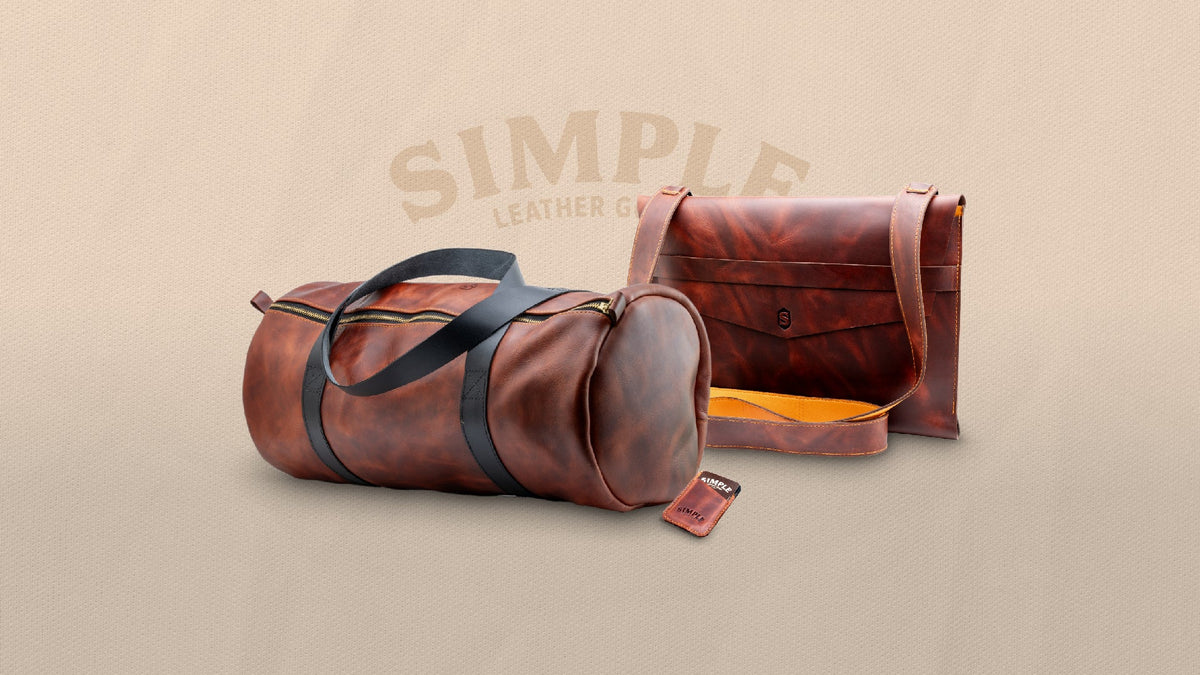
At SIMPLE we hand-select full-grain leather for our wallets, cardholders and bags because we want pieces that get better with age instead of wearing out. Each piece is cut by hand, saddle-stitched with waxed thread and edge-burnished in our workshop in Guatemala City. Full-grain takes a little longer to break in, but after a few months it feels like it was made for you.
If you already own full-grain leather, our leather care guide shows how to keep it in shape. To see what full-grain looks like in everyday pieces, browse our leather wallets, our leather cardholders and our leather bags.